CaroNet special projects
Project Meeseeks
Teaching intelligent machines to operate in a world built for us.
Our humanoid robotics research program explores how embodied AI can perceive, navigate, understand, and eventually perform useful physical work inside existing human environments.
Explore the system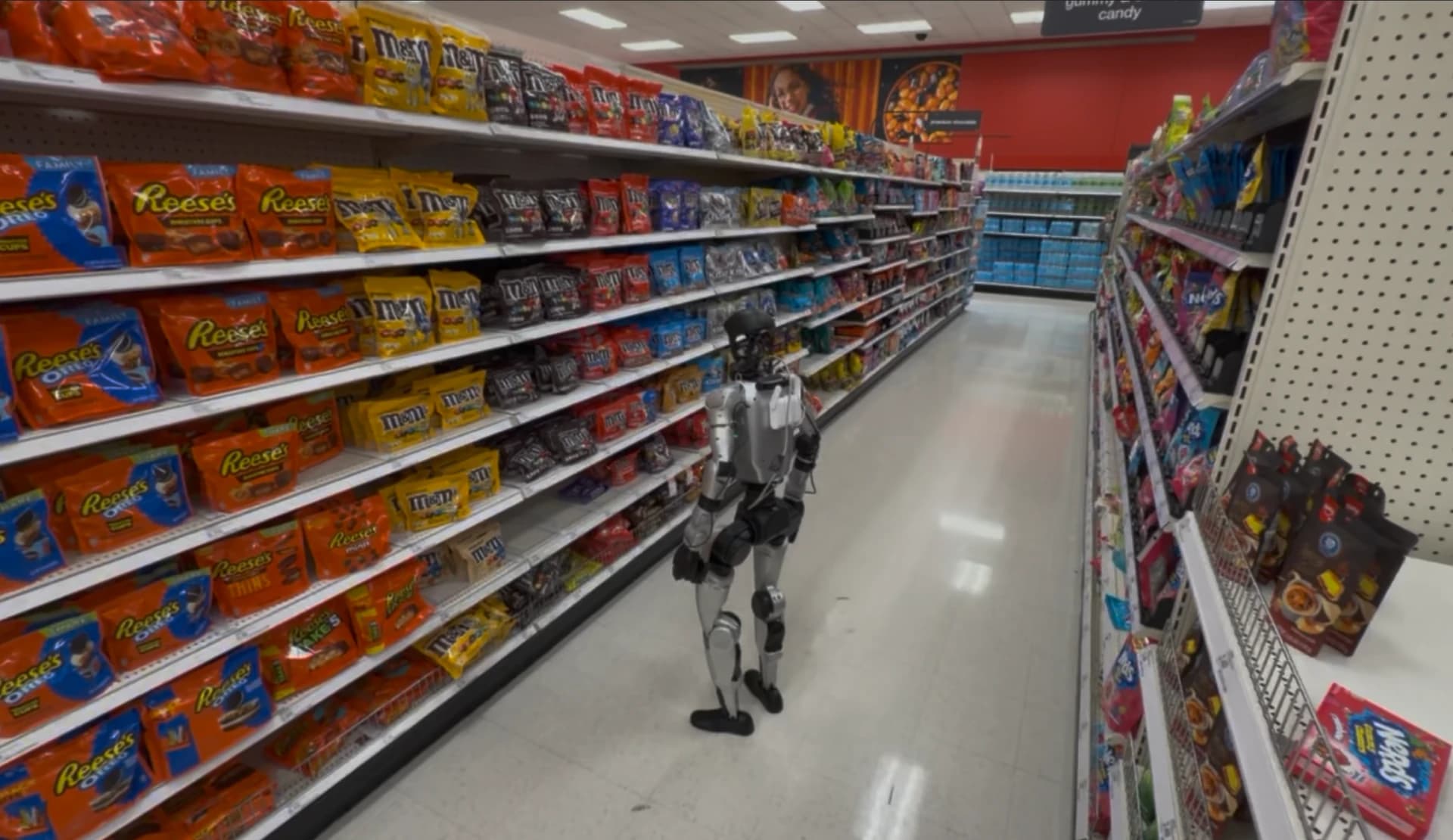
The question
What if the environment didn’t have to change for the machine?
Industrial automation often works by organizing the space around the machine. A retail store presents a different problem. Products move. Packaging changes. People cross paths. Carts and temporary displays occupy yesterday’s clear route.
Build the machine around the environment we already have.
System architecture
From observation to action.
Each step depends on evidence from the one before it. A task request is only the beginning.
- 01
Perceive
RGB / depth / LiDAR / robot state
Observe shelves and obstacles. Bring camera views and spatial sensing into the same task.
- 02
Understand
Embeddings / OCR / appearance
Compare product candidates, read useful text, and retain evidence across observations.
- 03
Plan
Maps / localization / task tools
Connect a requested task to a route and bounded actions. Check the available space before moving.
- 04
Act
Locomotion / scanning / recovery
Move, observe, and report what happened. Stop when conditions cannot be verified. Manipulation remains a research direction.
Real-world testing
Built in the lab.
Tested in the world.
A shelf is more than a collection of images. The robot has to reach it, hold a useful viewpoint, and collect observations while accounting for the space around it.
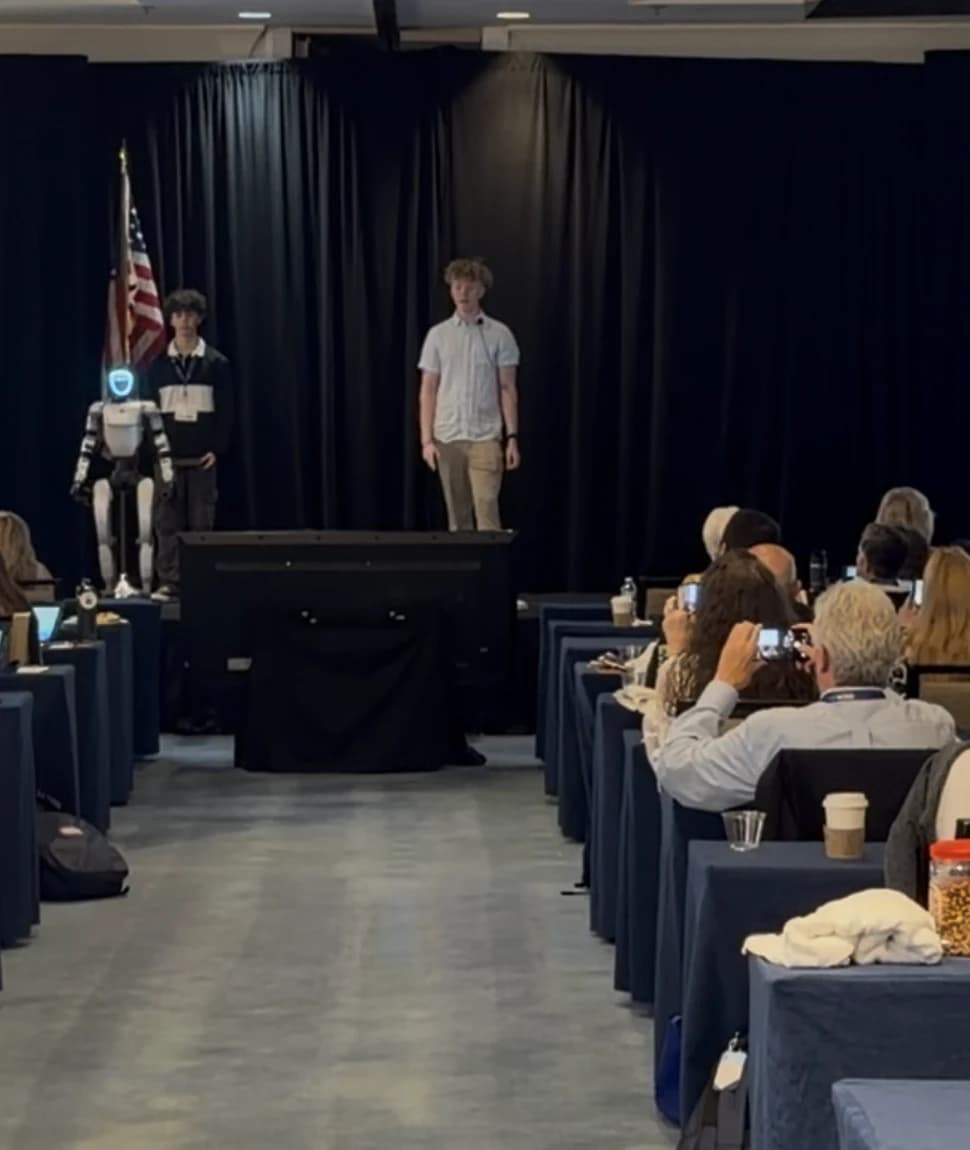
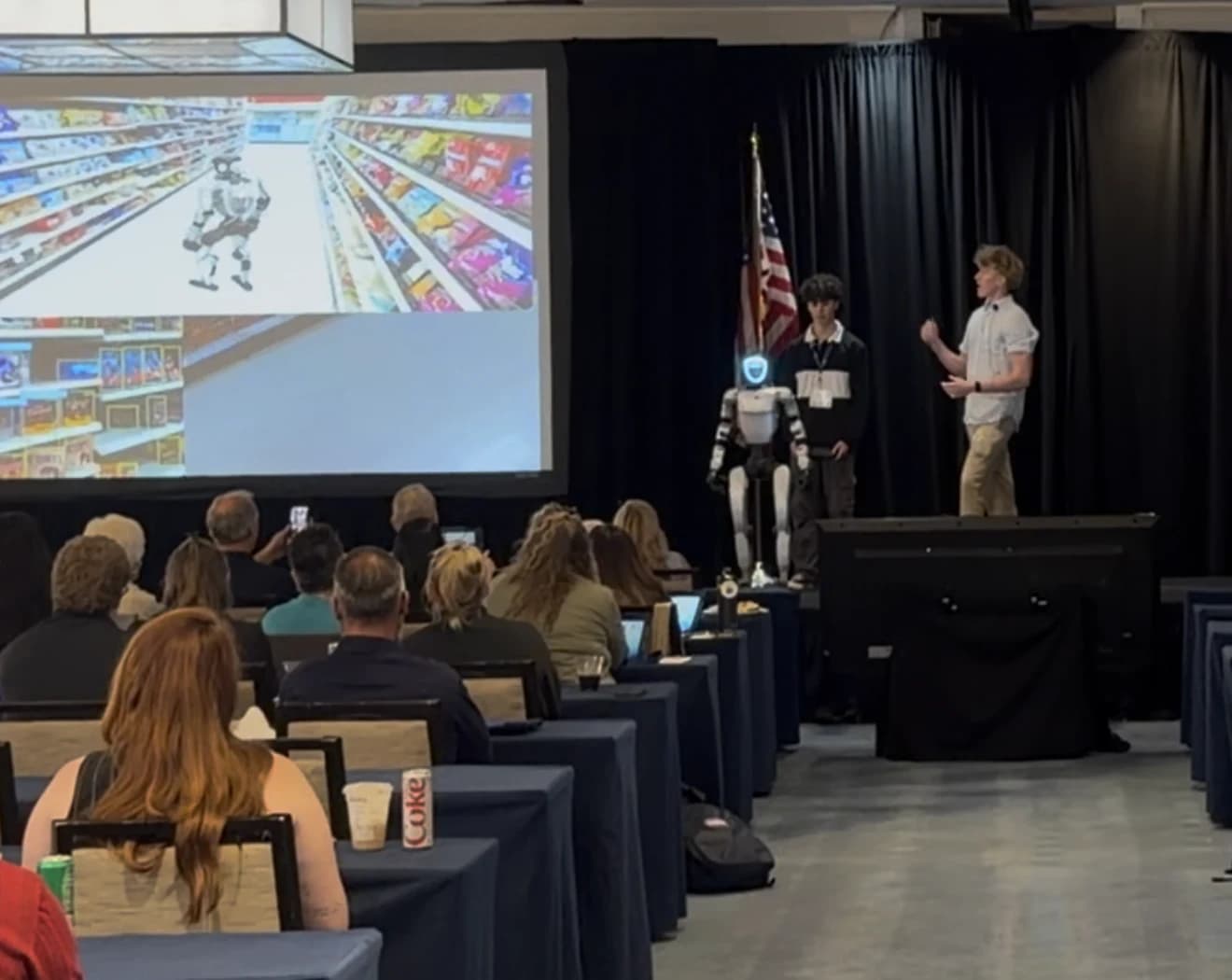
Field testing connects those pieces on physical hardware. Public demonstrations bring that engineering work out of the lab and into view.
Tests and demonstrations show specific conditions. They do not establish general-purpose autonomy.
Product recognition
Finding one product
among thousands.
Retail recognition is more than image classification. Similar packages sit side by side. Labels turn away from the camera. Products obscure each other. Lighting and packaging change, and a moving robot sees only part of the evidence in any one frame.
The recognition pipeline combines visual embeddings, candidate matching, OCR, and color cues. Shelf scanning collects repeated observations and produces confidence-ranked results.
Reliability also means knowing when evidence is insufficient. The current pipeline retains uncertain candidates with confidence and weak-evidence indicators. Treating an unresolved identity as unknown, rather than forcing a confident answer, remains an important design goal.
Perception / development output
What the system sees.
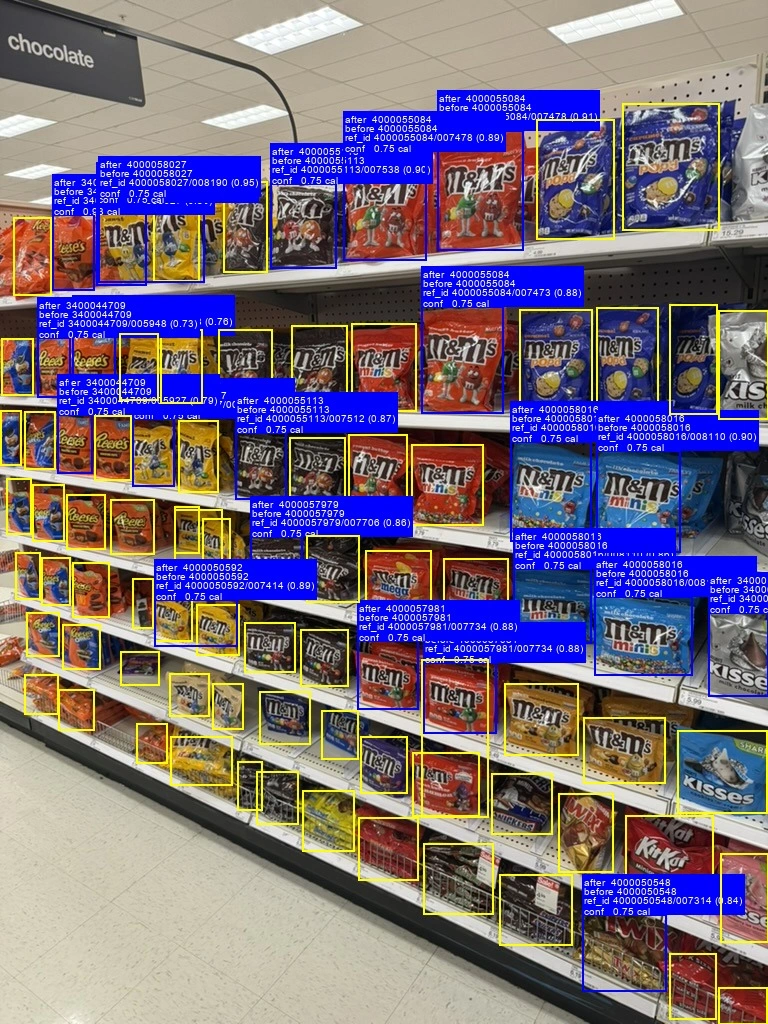
A shelf becomes a set of candidate regions to inspect. Each region can carry visual and textual evidence about a product.
This saved inference result shows product detections alongside predicted UPCs, reference matches, and confidence annotations. Similar packaging and partially obscured products appear together in the same view. This is development output, not an accuracy benchmark.
- Regions
- Detected product bounds
- Labels
- UPC predictions and confidence
- Context
- One observation within a scan
Navigation
The map never stays still.
Customers move. Employees stop in aisles. Carts appear. The robot can also lose a trustworthy estimate of its own position. A path through the map is only useful while its assumptions still hold.
The software connects SLAM-derived maps and localization with ROS 2 navigation, route planning, and obstacle checks. Task tools request bounded operations; motion controls check the conditions for carrying them out.
Supervision remains part of the system. Stale position data, obstructed space, or unavailable perception can stop a task. Recovery starts with checking what is known, rather than assuming the previous action succeeded.
The hard part
Robotics fails in the details.
- Perception
- Lighting, occlusion, packaging changes, and nearly identical products make recognition uncertain.
- Navigation
- A clear route can become blocked. A usable map does not guarantee a reliable estimate of the robot’s position.
- Manipulation
- Objects vary in pose, weight, and shape. Reaching a shelf and safely handling its contents are different problems.
- Reliability
- Camera failures, stale sensor data, and interrupted tasks need explicit stop and recovery behavior.
- Integration
- Useful work depends on fitting existing spaces, product data, and operator workflows.
Current state
A research platform,
not a finished worker.
Project Meeseeks is under active development. The current software provides a platform for testing perception, navigation, product recognition, and supervised task execution. General-purpose humanoid robotics remains a difficult long-term engineering problem.
Current engineering work
- Mapped navigation and localization
- Shelf scanning and product recognition
- Confidence-ranked scan reports
- Remote operator supervision
- Physical testing in retail environments
Research directions
- General manipulation and physical interaction
- Longer autonomous task sequences
- Broader environmental understanding
- More capable human interaction
- Higher reliability with less supervision
Long-term direction
The store shouldn’t have to be rebuilt for the robot.
Humanoid robotics asks whether machines can do useful work inside infrastructure that already exists for people. Meeseeks explores that possibility through specific, supervised tasks today. Broader autonomy and useful manipulation are research directions, without a promised completion date.
- Hardware platform
- Unitree G1 EDU
- Sensing
- RGB and depth cameras, LiDAR, robot state
- Software
- ROS 2, Nav2, CaroNet autonomy and perception software
- Program
- CaroNet Systems research and engineering
Public reveal / 2026
From internal project
to public program.
Developed privately before its public reveal in 2026, Project Meeseeks brings together the people, software, and physical testing behind our work in embodied intelligence.
Intelligence in physical environments. Part of a broader body of work in agents, enterprise systems, and security research.
Explore CaroNet projects