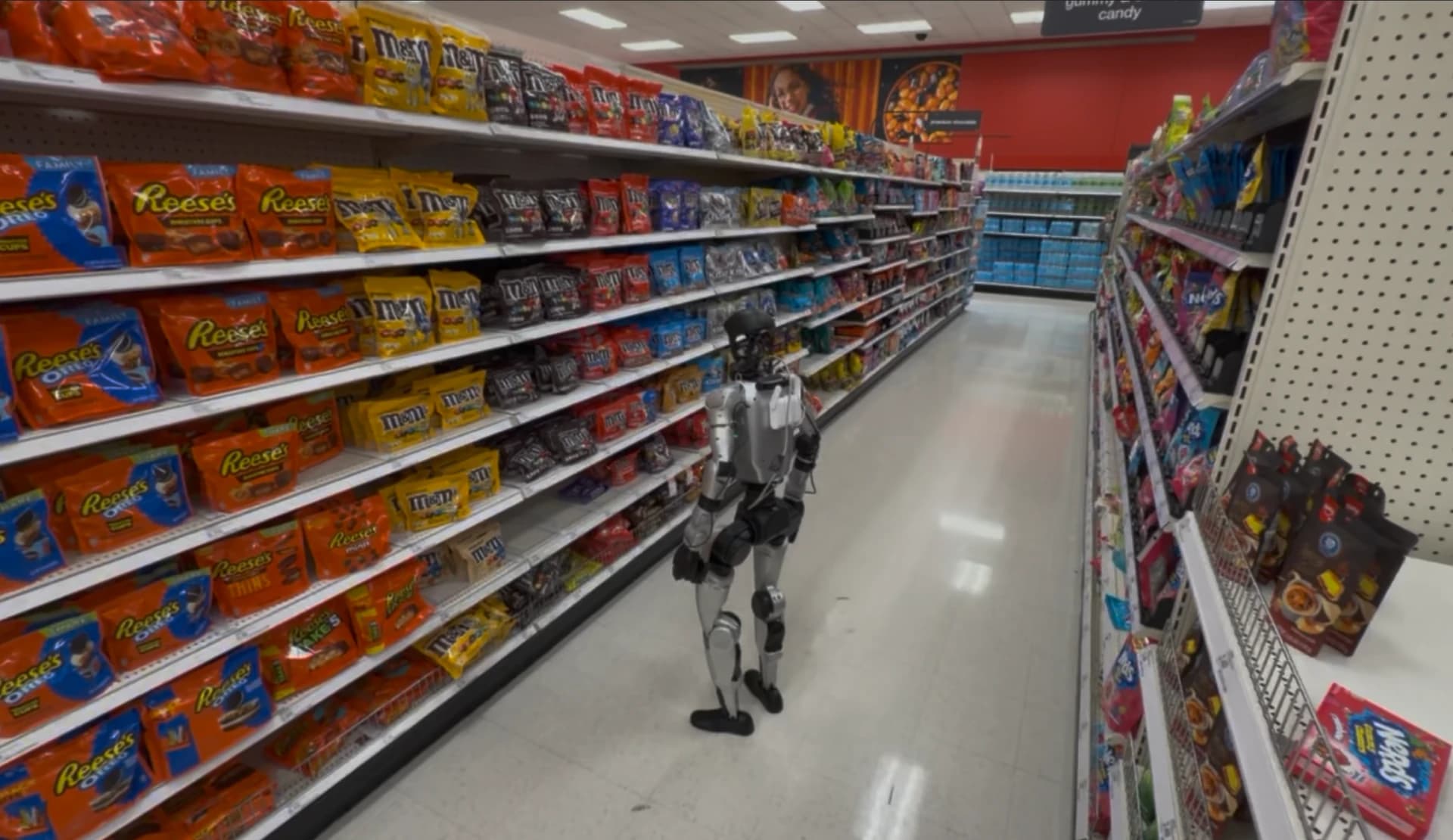
People going to shelves to scan can tell us a lot about what's on a store shelf. But someone still has to walk over and capture the images.
What if we didn't? What if the scanning system could go to the shelf itself?
That's the idea behind Project Meeseeks, CaroNet's humanoid robotics research program. We've been developing software on the Unitree G1 EDU to connect navigation with item scanning in real stores. We've tested it in retail environments, demonstrated it publicly, and can now share more of the work.
Meet Meeseeks
We started with a specific task: get to a shelf and identify the products on it.
That gives us a way to work on perception and autonomy together. The robot has to get into a position where its cameras can capture useful images. The recognition software then has to distinguish products that might look almost identical, sit behind other items, or appear at an angle.
A working detector is one part of that. Getting the robot to collect an image worth processing is another.
Assign. Capture. Review.
From the operator's side, the workflow is straightforward. Select shelves to inspect, let Meeseeks collect observations, and review the results.
Underneath that, we're connecting camera and LiDAR inputs with ROS 2 navigation and localization. The recognition pipeline uses visual embeddings, OCR, and appearance cues to compare product candidates. Repeated observations feed into confidence-ranked scan reports.
Testing outside the lab
Taking Meeseeks into a store puts the whole system to work. Camera placement affects recognition. Obstacles affect where it can stand. Similar packaging makes a confident prediction worth checking.
We've included testing photos and actual inference outputs on the project page so you can see both the robot and what the software is doing with its observations.
Meeseeks is still a research platform. We're working on navigation and shelf scanning under supervision, with longer autonomous tasks and manipulation as research directions. There's substantial work left before a system like this can operate reliably with less supervision.
For now, we have a physical platform, a concrete task, and a lot to build on. We'll share more as the work progresses.